

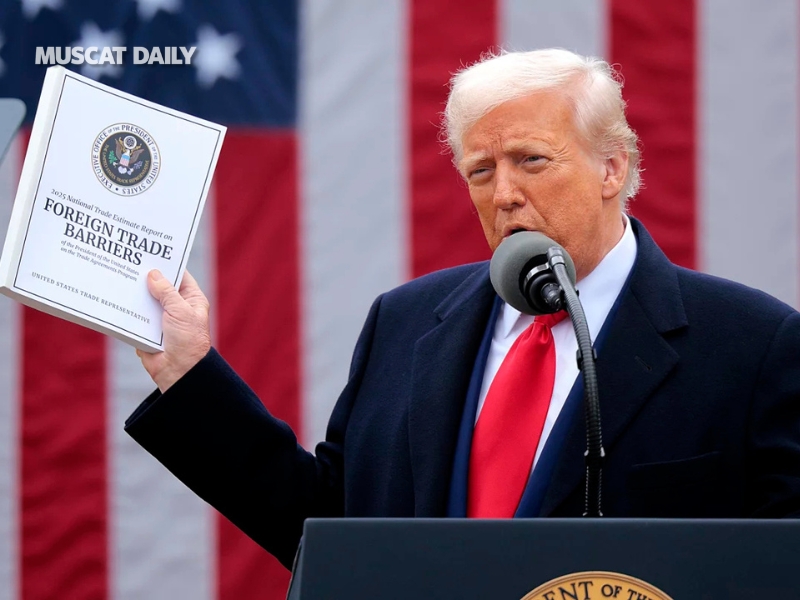

Washington, US – President Donald Trump has announced a significant escalation in US trade policy, declaring he will impose a 15% global tariff on all imports. The move comes as a direct challenge to a landmark Supreme Court ruling on Friday that struck down his previous trade taxes as unconstitutional.
The President originally stated on Friday that he would introduce a 10% levy to replace the duties invalidated by the court. However, in a statement released on Saturday via Truth Social, he confirmed the rate would be increased to the maximum 15% permitted under Section 122 of the 1974 Trade Act. This specific provision, which has remained largely unused in modern history, allows the executive to bypass Congress for a period of 150 days to address international payment imbalances.
The administration’s decision follows a 6-3 Supreme Court verdict which found that the President had overstepped his executive authority. The justices ruled that the 1977 International Emergency Economic Powers Act (IEEPA), which the President had used to collect an estimated $130bn in duties, did not grant him the power to impose sweeping global tariffs. Trump reacted with vitriol to the decision, describing the ruling as “extraordinarily anti-American” and labelling the justices who rejected his policy as “fools”.
The sudden increase to 15% has created immediate diplomatic and economic friction, particularly for nations like the United Kingdom and Australia. Both countries had recently reached individual agreements with the White House for a 10% tariff rate, which now appear to be superseded by the new global baseline. While the initial 10% levy was scheduled to take effect on Tuesday, February 24, it is currently unclear if the higher 15% will be implemented on the same day.
Under the 1974 Trade Act, these emergency measures are temporary. The administration must seek formal congressional approval to extend the tariffs beyond the initial five-month window. Legal experts suggest that this new strategy may also face swift challenges in the courts, as the President continues his effort to reshape global trade through executive action.