


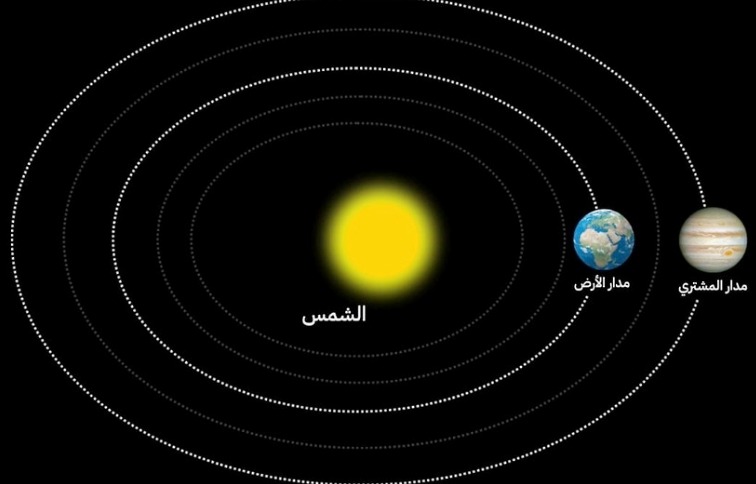
MUSCAT : The society announced that Jupiter will reach opposition at 12:34 pm Oman time, a phenomenon that occurs when the giant planet, Earth and the Sun align in a near-straight line, placing Jupiter directly opposite the Sun from Earth’s perspective. This alignment brings Jupiter to its closest annual distance from Earth, estimated at around 633 million kilometres.
Al-Mukhtar bin Saif Al-Saidi, head of astronomical programmes at the society, said Jupiter will shine with an apparent magnitude of about -2.8, making it brighter than most stars and easily visible to the naked eye across different regions of Oman. During this period, the planet will appear at its largest and most luminous, offering ideal conditions for observation and astrophotography.
Jupiter will rise over Muscat’s horizon at 5:29 pm, reach its highest point in the sky around midnight, and set at 6:54 am, remaining visible for most of the night. It can be seen in the constellation Taurus, starting low on the eastern horizon after sunset before moving westward as the night progresses.
Al-Saidi explained that Jupiter is the second brightest planet in the solar system after Venus and one of the most prominent objects in the night sky after the Sun and the Moon. Classified as a giant gas planet, it is the largest planet in both size and mass and does not have a rocky surface.
Using small binoculars, observers can spot Jupiter’s four Galilean moons, while telescopes reveal striking details such as its cloud bands and the famous Great Red Spot. The planet will remain visible in the night sky for several months following opposition, before gradually fading as it approaches the Sun, eventually reaching solar conjunction on July 29, 2026, when it will disappear from view.
Highlighting Jupiter’s scientific importance, Al-Saidi noted that its immense gravitational force plays a vital role in protecting the inner solar system by deflecting or capturing comets and asteroids, earning it the title of the “shield of the solar system.” Its presence has also helped maintain the long-term stability of planetary orbits around Earth.
The opposition of Jupiter occurs roughly once every 13 months, due to differences in orbital speed, with Jupiter completing one orbit around the Sun in about 12 Earth years, compared to Earth’s single year.
For all the latest news from Oman and GCC, follow us on Twitter, Instagram and LinkedIn, like us on Facebook and subscribe to our YouTube page, which is updated daily.